Pope Leo XIV’s Visit to Cameroon: Three Cities, Three Intertwined Realities
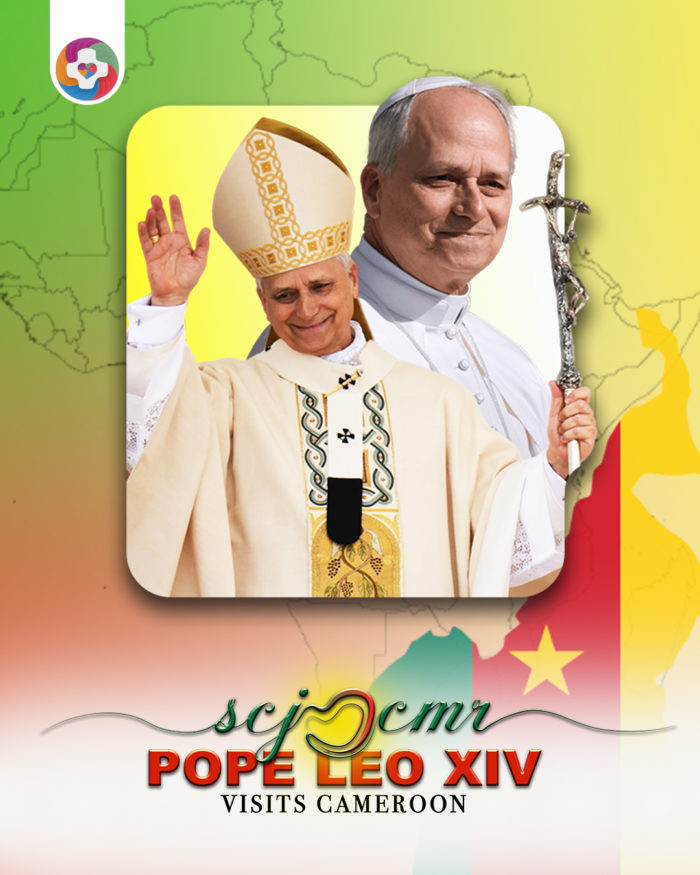
As a messenger of peace, Pope Leo XIV begins his first apostolic journey to Cameroon this April 15. A mission land for the Priests of the Sacred Heart since 1912, it is now facing profound internal crises.


The countdown has begun. This April 15, Pope Leo XIV will step onto the tarmac of Yaoundé-Nsimalen airport for his first apostolic journey to Cameroonian soil, where the Priests of the Sacred Heart have worked continuously since 1912. The second stop on his African tour after Algeria, the Holy Father’s stay will last until Saturday, April 18, 2026. Yaoundé, Bamenda, and Douala—the three cities on the itinerary—are home to several Dehonian communities. There, in direct proximity to the people, the SCJ religious share the daily lives of populations marked by persistent socio-political, educational, and security crises.
Yaoundé: A Dehonian Pastoral and Academic Presence
The Holy Father will inaugurate his visit in Yaoundé, the political capital. He will meet with the President of the Republic, Paul Biya—a former seminarian who has been in power since 1982—before addressing the authorities, civil society, and the diplomatic corps. A meeting with the bishops of Cameroon is also scheduled for the same day.
In Yaoundé and its surroundings, the Priests of the Sacred Heart are in charge of four parishes and are present in the university environment, notably at the Catholic University of Central Africa (UCAC), with two professors and several students in various faculties. A major meeting with the academic world is planned at this institution on April 17. “For my part, I especially expect the Pope to forcefully remind us of the fundamental mission of educational institutions,” confides Father Jean Marie Signié SCJ, Priest of the Sacred Heart and professor of canon law at UCAC.
For him, the stakes are high, given the many challenges facing educational and university institutions in Cameroon: “All true education must aim for the integral formation of the human person: intellectual, moral, spiritual, and social. This is precisely the vision we seek to promote, particularly at the Catholic University of Central Africa.” However, Father Signié does not hide his concern regarding certain current movements. According to him, the Pope must address a university environment sometimes weakened by “esoteric sects” and “ideological groups opposed to the Church.”
This Dehonian presence at UCAC is historical. “Since the university opened in 1991, the Priests of the Sacred Heart were already there, as teachers and students,” emphasizes Father Signié, who has been with the canon law department—founded by the Priests of the Sacred Heart—since 2005.
Bamenda: Proximity Ministry in a Crisis Context
On April 16, Leo XIV will fly to Bamenda. He will land on a tarmac long neglected in the heart of the bush but recently renovated for the occasion. This will be the stage most charged with emotion and political stakes. Since 2016, the North-West and South-West regions have been the scene of a bloody conflict between Anglophone separatist groups and government forces.
Father Salomon Édinguèlè SCJ, head of the French-speaking Catholic community in Bamenda, awaits this moment as a “spiritual liberation.” He describes a wounded daily life: “What was initially a grievance turned into a conflict that has caused enormous suffering: thousands of deaths, displaced families, and a climate of division. Many of our faithful had to flee the violence carried out by their own neighbors.”
For him, the Pope’s visit is an act of “reparation.” But can it silence the guns? Father Salomon wants to believe so: “We are already seeing encouraging signs: the city is mobilizing, work is resuming, and even some armed groups are calling for a truce to welcome the Holy Father. It is a true glimmer of hope.”
Present in Bamenda through a formation house and a parish, and in two other villages in this region, the Priests of the Sacred Heart have remained in solidarity with the people during this decade of fire. It is by virtue of this context of instability, where peace is permanently suffering, that Father Édinguèlè expects the Holy Father to be “a prophetic voice, capable of reminding everyone that we are called to live as brothers and sisters, sons and daughters of the same Father, in justice, truth, and love.”
Douala: A Parish Presence with a Social Outlook
The final stage of this papal journey to Cameroon will be Douala, the bustling economic metropolis. Here, the Pope will witness firsthand the contrasts of a city where growth coexists with poverty; where luxury overlooks precarity. In Bonabéri, a popular neighborhood, the Priests of the Sacred Heart, through their presence and ministries, try to restore hope to a population despaired by the socio-economic situation, including unemployment and poverty, as testified by Father Florian Nana Simo, SCJ, parish priest of St. Timothy of Sodiko, whose access requires particular gymnastics during the rainy season. Regarding the Pope’s visit to the city of Douala, he joyfully notes the enthusiasm of the faithful: “For them, this visit from the Holy Father comes to strengthen contrite hearts.” He will participate, along with his colleagues and parishioners, in the grand mass scheduled for April 17, 2026, at the Japoma Stadium (50,000 seats): “We will be there to show that the Church remains the last rampart against despair,” he concludes.
A New Breath
In three days, Leo XIV will have traveled through three faces of Cameroon: the capital that decides, the region that suffers, and the metropolis that works. Between the prophetic expectations of Father Edinguèlè in Bamenda, the academic demands of Father Signié in Yaoundé, and the pastoral realism of Father Nana in Douala, the Sovereign Pontiff must find the words to heal the wounds of a nation in search of landmarks. A breath of hope that he will then carry to Angola and Equatorial Guinea, upon his departure on April 18.