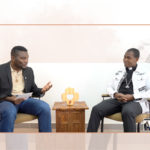
“Here, I was welcomed like the beloved child”: The testimony of Moriba, a Muslim refugee welcomed by the Dehonians in Rome.
Kidnapped during the 2013 conflict in Mali, and a survivor of both the desert and the Mediterranean Sea, Moriba is now a healthcare assistant in Rome. In this interview, he reflects on his journey and his fraternal relationship with the Dehonian community of the Generalate.


Moriba Keita (30), originally from Mali, is a friend of the Generalate community of the Priests of the Sacred Heart, where he was welcomed at the end of his mandatory legal reception and integration period in a reception center for asylum seekers in Rome. In this interview, he looks back with emotion on his integration journey and on the seven months spent within the community of the Priests of the Sacred Heart (Dehonians). A luminous testimony on fraternity,perseverance, and mutual respect beyond cultural and religious differences.
Moriba, you lived for seven months in the Generalate community of the Priests of the Sacred Heart, with whom you formed deep bonds of friendship. How did you come into contact with this community? Where did this connection come from?
I was in a public reception center in Rome. At the end of the program, once you get your papers, the center asks you to find accommodation because their job ends there. You receive a small financial exit allowance, but it is nowhere near enough to rent an apartment, especially without stable employment. It was a very distressing time; I didn’t know what to do. It was then that Sister Maria—a wonderful religious sister who visited us regularly and with whom I later collaborated as a volunteer—heard about my situation. She told me: “Don’t worry, I will take you to a place where you can take your time, study, find a job, and save money.” She was the one who brought me to the Priests of the Sacred Heart, into this Dehonian community, toward the end of the Covid-19 period. I was sheltered there for seven months.
How did this period of hospitality within this religious community go?
My stay in the community was such a profound experience that I will never forget it. Even after leaving to work for a few years in France, I never broke contact. Never. At the time, Father Bruno, Father Carlos, and many others were there… To me, they became a real family. They gave me everything. The house was at my disposal. When I would return in the evening, discouraged after days spent looking for work or an apartment without success, they would come to me and comfort me. During those seven months, I was able to finish my studies, pass my driving test, find a job, and set aside money to rent my own home. When the time came to leave, they told me: “It’s not over. The house remains open to you; you come whenever you want.” They treated me like the beloved child of the family.
If things hadn’t gone so well, I would never have thought of coming back today. In fact, even when I found my own apartment in Rome, they would write to me: “Come spend Saturday or Sunday with us!” So I would come, we would share a meal, and then I would head home. It was truly an unforgettable experience.
You are a Muslim, and you lived at the heart of a Catholic priests’ community. How did you experience this daily contact with Catholicism, and what did you take away from it?
That was the very thing that touched me the most: the way I was welcomed, knowing that I am Muslim and they are Christians. Truly, it was total respect. You know, until you have lived it, it is hard to believe that a Muslim and a Christian can live together like that. All these Fathers of the community respected me deeply and respected my religion.That was something truly great for me. At meals, they were attentive to the food: they prepared chicken separately on days when pork was served, and they always set a non-alcoholic drink next to my plate while they had wine. That delicate attention, that simple fraternity—that is true coexistence.
Your arrival in Italy was preceded by a particularly painful journey. Why and under what circumstances did you leave Mali?
Everything changed in 2013, with the war. I was still a student. During the school holidays, we had traveled north when armed jihadist groups raided the area. They captured us, threw us into the back of pick-up trucks, and locked us in a hangar for several days. They beat us and demanded information about the positions of the Malian army, even though we were just teenagers. I was one of the youngest in the group. One evening when they had stepped out, we managed to force open the door and flee into the desert. We walked all night and most of the following day, under a scorching sun and through desert sandstorms. Exhausted, we were rescued by a merchant in his truck who happened to be passing by and took us to Algeria.
How did you eventually reach Europe?
Once in Algeria, he freed all the others except me. He felt I was too young and told me: “I have children your age. Come with me.” Not knowing who to trust anymore, I hesitated at first. But having nowhere else to go, I agreed to let him take me home. There were indeed children my age there. He owned several shops. Going there with his children, I began to settle in and learn the trade.
Then one day, armed men burst into the shop and kidnapped me. They threatened to kill me. I had no idea where they were taking me. We eventually crossed the border into Libya. There, I was taken by force to the coast. I had never seen the sea in my life. I was forced onto a makeshift boat alongside many other refugees. It was terrifying; I thought I was going to die at sea. But God is great. I did not expect to survive; I thought my life was over. Then, we were rescued at sea by large ships. That is how I arrived in Italy. I thank God. It is incredible. That is how I arrived in Italy. I truly thank the good Lord. Along my path, I ultimately met only kind-hearted people. And here in Italy, I found this community,which became my family.
Once in Rome, how did you rebuild your life?
At first, life in the reception center was harsh, marked by learning the language, dealing with administrative paperwork,and waiting for appeals on residence permits. A Senegalese volunteer, Mariam, noticed my determination and how quickly I was learning; she directed me toward training for civic service (servizio civile). During that service, I was assigned to assist elderly and vulnerable people. That was where I found my calling. Seeing the dedication of the healthcare workers—especially a colleague named Jean in his white coat—I said to myself: “This is the work I want to do.”
I saved every euro of my allowance and worked night shifts caring for dependent elderly persons to pay for my studies.I then obtained my official certification as a socio-sanitary operator (OSS, certified healthcare assistant). Today, I work in hospitals and care homes. Wherever I have worked, I have found wonderful Italian colleagues and friends who supported and guided me through every difficulty.
You were recently able to return to Mali for the first time in 10 years. How was the reunion?
It was in July 2025, exactly ten years after my departure. All that time, my family had had no news and didn’t know whether I was still alive; many believed I was dead. When I arrived, everyone was crying, singing, and dancing for joy.I cried too. Sadly, my mother passed away during my absence, which was a huge sorrow, but I was able to go visit her grave. During that stay, I also got married. My wife is currently in Mali, and as soon as my housing and work situation is completely stabilized, I hope with all my heart to bring her to Rome to introduce her to my “Italian family,” the Dehonian fathers.
What message would you like to share through your story?
First, a message of hope and willpower: when life puts you to the test, with faith, hard work, and sincere commitment,you can overcome any obstacle. Second, a message about meeting others. We must not judge people based on prejudice or rumors. The way people view you begins above all with the way you present yourself to them, with respect and honesty. What I lived with the Priests of the Sacred Heart has marked me forever. Their generosity and fraternal welcome proved to me that human dignity and respect transcend every barrier.