Ecuador : Mission for the Reign of the Sacred Heart – First Period (1887 – 1889)
In 1888, the first Dehonian mission outside Europe was inaugurated with Fathers Gabriel-Marie Grison and Irénée Blanc. Following the second phase of the Dehonian jubilee in Ecuador, the Dehonian Studies Center (CSD) offers us a look at this mission through the letters between Father Dehon and the missionaries involved.


Initiated in November 1888 by Fathers Gabriel-Marie Grison and Irénée Blanc, the mission of the Congregation of the Priests of the Sacred Heart in Ecuador was a brief but incredibly intense adventure. We propose a look at this mission starting from the correspondence between Father Dehon and the figures involved in this enterprise. Through the letters, a portrait emerges of a mission torn between the missionary ideal for the Reign of the Heart of Christ and the reality of a territory marked by countless difficulties and violent revolution. Through these writings, one discovers not only a complex missionary adventure—traversed by constant material difficulties, growing political tensions, and intense formative demands—but above all the profound theological and pastoral thought of our Founder and the Dehonian missionaries. The presentation of the letters will be divided into two parts: the period between 1887-1889 and the period between 1890-1896.
First Period (1887 – 1889)
In the nineteenth century, Paray-le-Monial experienced a new flourishing period. The message from the saint of Burgundy was reinterpreted at the heart of the social revolution. During this time most institutions were being downsized by virtue of a new anthropology that separated the spirit from worldly reality. For Catholics of that era, this social concept was nothing less than a scandal and, effectively, an impetus to rethink and re-propose the Christian faith in a profoundly evolved world. Obviously, the methods that might have seemed original at the time are completely outdated today, given that the opening of a Christian art museum no longer makes any impression. Furthermore, for Dehon, the movement taking shape around the Shrine of the Sacred Heart apparitions represented an attractive proposition, and in the movement’s bulletin, Le Règne de Jésus-Christ, he found news about the work of Jules Matovelle, founder of the Congregation of the Oblates of the Divine Love.
The Congregation of the Oblates and, subsequently, that of the Priests of the Sacred Heart were undoubtedly born as teaching congregations, but at the same time, their ecclesial mission underwent a sort of rewriting in which the work of reparation was transformed into a rather multifaceted apostolate, in line with immediate needs. Dehon’s attention, seeming to seize the opportunity provided by the foundation of St. John’s College, turned to various works, including the formation of the clergy in a broad sense and the Ad gentes missions. In 1882, in response to the encyclical Sancta Dei Civitas on missions, he wrote to the pope on behalf of his society to affirm their readiness to soon be represented in the missions as well, particularly in countries where the faith had long been obscured by schism and where priestly reparation seemed to be one of the primary means of regeneration. Zeal for the Kingdom of God truly found its most direct realization in the willingness to send missionaries exactly where the Kingdom had not yet taken concrete form. In the period following the Consummatum est and in anticipation of the issuance of the brief of praise, Dehon also felt the pressure to present his new institute as useful to the Church. In this context, he wrote to Baron Sarachaga, one of the leading figures of the Paray movement (see Letter 1).
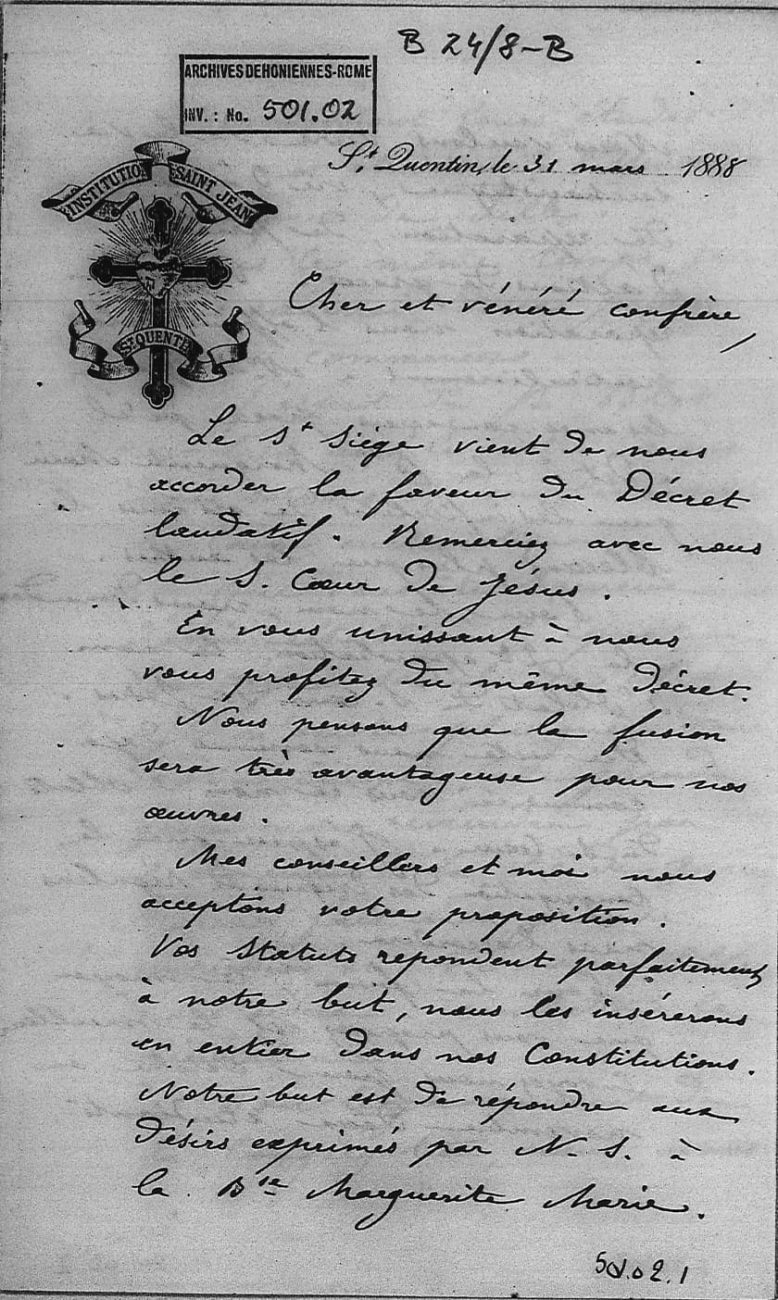
Baron put Dehon in contact with the aforementioned Father Matovelle, with whom Dehon began an intense correspondence that seemingly would not cease even after their rupture in 1889. We have several letters from Fr. Dehon to Fr. Matovelle, but only three replies from the latter, only one of which dates to the period of interest, discussing the feast of the Sacred Heart and the desire for the missionaries to take part in it. From the very beginning, Dehon sought to provide a rather detailed presentation of his institute’s constitution (see Letter 2) and the sources of its spirituality (see Letter 3). The two letters offer a unique view of the specific spirituality that Dehon intended to transmit to the Priests of the Sacred Heart during the era of the Decretum Laudis. The fusion project did not merely aim to share rights and ecclesial standing but also represented a first attempt to insert the Dehonians into a parallel, yet undoubtedly different, ecclesiastical and social tradition. The space in which this fusion was realized was the concept of the Eucharistic Heart of Jesus, particularly adoration, of which the half-hour was a strong claim of Father Matovelle. The mission in Ecuador was unique because our confreres were not there for a vaguely and indeterminately conceived apostolate, but to realize their own purpose (at the time, the term “charism” was not used at all). Moreover, the implementation of this goal had to take place in a context of encounter and union that shattered the principle of separation that enchanted the world of that time and pushed it toward individualism and egocentrism.
The Reign of the Sacred Heart had to appear precisely in this union of hearts devoted to the Sacred Heart, driven by zeal to reach the indigenous people, according to Leo XIII’s invitation to go out to the people. A significant element of this disposition is seen in the Dehonians’ competition in building the national votive basilica on the model of the one in Montmartre, in the Gothic style.
The project failed to reach a successful conclusion. On August 5, 1889, Dehon wrote to J. Matovelle that he had listened to calumnies. To understand these events, which remain somewhat unclear today primarily due to gaps in the sources, it is necessary to note that Matovelle’s vision of the Kingdom was fundamentally political, rather than social in the sense Dehon considered it. One cannot ignore the nationalist dissensions and the strong distrust of Europe (which was partitioning Africa following the Berlin Conference); in a moment of emancipation, Europe could represent to Latin Americans an emanation of the very things they wanted to reject, even daring to speak of the Romanization of the Church. Ultimately, Dehon’s telegram instructed the missionaries to place themselves at the disposal of Bishop Schumacher of Portiviejo. The first missionaries, Fathers Irénée Blanc and Gabriel-Marie Grison, were thus able to begin pastoral activity with the poor people of the new diocese, describing their lives to Father Dehon (see Letter 4). Fr. Sébastien Miquet, meanwhile, took charge of the apostolic school in Bahía de Caráquez. Leaving the European context led our young community to make itself available once again, partly recapturing the very spirit that left Dehon restless when Love was not yet loved everywhere.
Lett. 1. Léon Dehon to Alexis de Sarachaga
[Saint-Quentin], June 8, 1887
I read Fr. Matovelle’s article in the Bulletin with great interest. I share the ideas of this man of God. Our small, nascent congregation of the Priests of the Sacred Heart would love to exercise its zeal in countries where the faith is suffering because of the clergy. Devotion to the clergy is our goal. We would gladly go and found clerical schools in South America a little later on. We are still few in number: about sixty, of whom twenty-five are priests. You are at the source of the graces of the Sacred Heart in Paray-le-Monial; pray a little for us. Send us some vocations when opportune. Ask the Sacred Heart for the grace that we might found a clerical school in Paray and another one in Ars. These are two sources of priestly graces. Ask for the prayers of Fr. Matovelle and his committee on our behalf. Please accept the expression of my religious respect,
Dehon
Download below the correspondence between Father Dehon and the first missionaries in Ecuador.