Ecuador: Mission for the Kingdom of the Sacred Heart – Second Period (1890-1896)


In the aftermath of the failed merger of the Congregations, as early as September 1889, the Dehonian missionaries left Quito for Portoviejo. The development of the mission in Ecuador seemed promising at that time, as it could count on the support of the Bishop of Portoviejo. However, the missionaries found themselves facing continuous difficulties in Ecuador, caused by multiple factors: fluctuating relations with the Bishop, the question of unity among the missionaries, the threat of liberals and Freemasonry, the unstable political situation, and other challenges related to the climate and infrastructure. Faced with such difficulties, Father Dehon realized the need to revise his plans, noting that in Ecuador there was only the possibility of having one or two small colleges (Letter 1), while simultaneously foreseeing the possibility of expanding the mission to other South American countries.
Problems with the Bishop led the missionaries to settle in two main hubs: Ambato and Bahía. Starting in 1891, the organization of the mission was defined by stabilizing the Dehonian presence in these two locations and seeking new ways to strengthen it. Fr. Dehon saw the possibility of making the house in Bahía function as a provincial house, serving as the canonical seat for scholastics and novices. In the same year, Fr. Dehon meticulously organized the sending of reinforcements, divided between Ambato and the school in Bahía (Letter 3). The college in Bahía welcomed about fifty students, while in Ambato the community educated forty students and exercised a ministry in the city through confessions. In addition to educational work, they also served as parish priests with intense ministries (Letter 4). They confessed abundantly, spiritually accompanied the dying, and engaged in rural evangelization. At the same time, they ensured the internal formation of their future priests by drafting plans for theological studies. The mission benefited from fertile ground, working with a simple, good people of “truly angelic purity” despite their lack of religious instruction, as well as the support of Msgr. Schumacher, despite some tensions that arose between the bishop and the Dehonians.
Internally, the missionaries faced the challenge of building unity among themselves and living the spirituality of the Congregation in difficult situations. Amidst the problems affecting the Dehonians, Fr. Dehon incessantly encouraged them and guided them to focus on the deep meaning of their mission. He exhorted the missionaries to live the spirit of sacrifice and abandonment to make their mission an offering to the Sacred Heart and to live in unity with one another (Letter 2). To this end, he recommended the interior attitude of “Mitis et humilis corde” (Meek and humble of heart), urging them to do everything with humility and peace (Letter 3), and not to lose joy amidst danger and chaos. These principles guided their daily lives: progressing day by day in holiness, remaining faithful to monthly retreats, and striving to faithfully fulfill spiritual exercises to make possible their offering of love and reparation to Christ.
As early as 1893, the missionaries became aware of the growing threat from liberals and Freemasonry. On many occasions, revolutionaries sought to attack the Church. Religious figures were insulted and forced to flee; some were dragged by their feet or shot. Bishop Schumacher, condemned to death, managed to escape by a miracle, fleeing for a month in the virgin forest and surviving on roots while some of his companions died of hunger. Finally, the Church in Ecuador was hit hard by the liberal revolution of Eloy Alfaro (1894-1895). Faced with bands of “montoneros” (bandits), the missionaries of Bahía even had to arm themselves for defense. The increasing insecurity forced the missionaries to abandon their mission posts (Letter 5). Despite this chaos, the spirit of oblation remained intact; they placed their destiny in the hands of Providence for the present and the future. The mission officially ended with this expulsion on June 12, 1896.
The epic of the Dehonian mission in Ecuador goes far beyond the simple framework of an educational or pastoral enterprise; it is fundamentally a work of sacrifice for the establishment of the Kingdom of the Heart of Christ. Despite the spectacular material destruction of their colleges and the dispersion of their communities caused by Masonic and revolutionary fury, the missionaries never lost sight of their primary vocation: to offer the Lord love and reparation. Guided by Father Dehon’s incessant calls to holiness, the spirit of faith, and humility, these missionaries demonstrated that the true Kingdom of Christ is not built on the stone of buildings destined to crumble, but in unshakable obedience to the divine will. Fr. Dehon’s words to his missionaries in 1896 summarize the essential meaning of the mission: “Be truly supernatural. Act solely through the spirit of faith. What does it matter if we serve Our Lord on one shore or another? What matters is doing His will” (Letter 6).
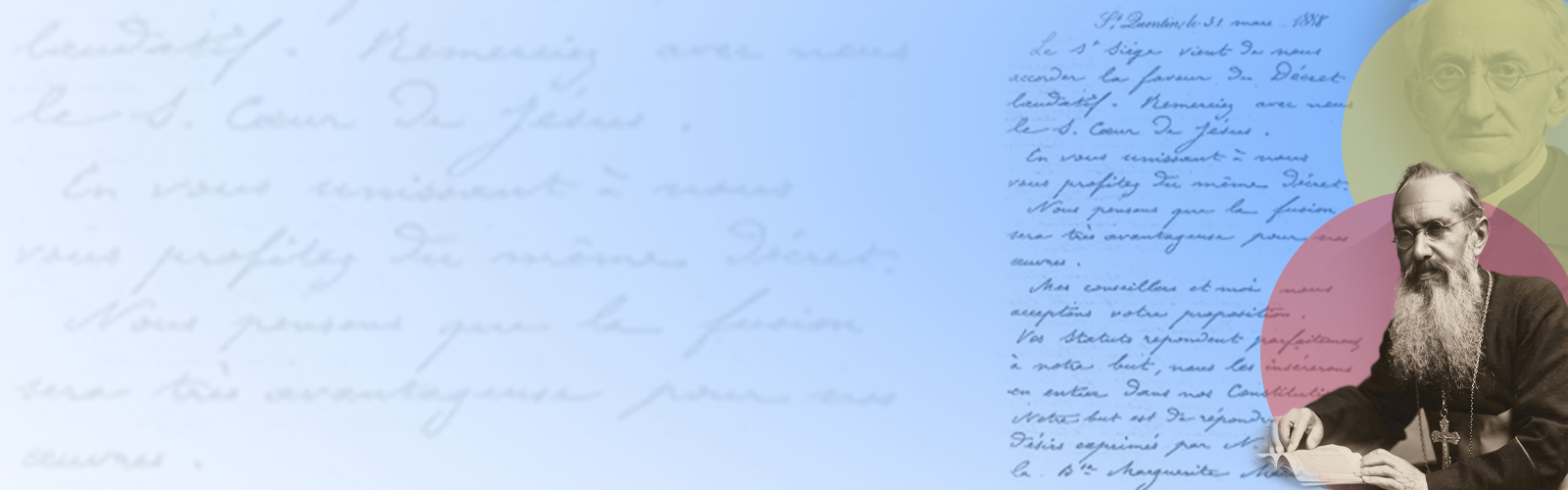
Letter 6 | [Léon Dehon to Gabriel-Marie Grison] January 15, 1896
Dear son,
I have nothing important to tell you; however, I send you a few words of encouragement.
We are in the hands of Providence. Let us allow ourselves to be guided by it. Fulfill your mission in Bahía until the good Lord clearly indicates that it is time to depart. You are setting a great example there.
Be truly supernatural. Act only with a spirit of faith. What does it matter if we serve Our Lord on one shore or the other? What matters is to do His will.
Do not be agitated. Perform your spiritual exercises well and calmly to render to Our Lord the tribute of love and reparation that He expects from us.
We are well here and everyone is working.
I bless you affectionately.
+ Jean du Cœur de Jésus
Download the correspondence between Father Dehon and the first missionaries in Ecuador below.